I remember the exact moment my thinking about fitness changed — when it stopped being about looking good and turned into something else entirely.
We were traveling with friends and signed up for a guided cave-exploring tour, open to the public. Six of us, no kids in our group. They paired us with a larger group of 20 to 25 people, some of them young kids.
The tour had a few tight spots — nothing crazy, easy enough that five-year-olds were getting through fine. But I watched grown adults struggle through basic movements anywhere there wasn't a handrail to grab. For some of them, I felt for them. Maybe they were carrying old injuries, who knows. But that didn't explain everyone.
It didn't explain the dads. I'm not talking about old guys with bad knees. I'm talking late-30s, early-40s guys — my age — already gassed and sweating before we hit the first tight squeeze. That sounds harsh. Let me explain why it stuck with me.
At the apex of the tour, we came up into this wide-open cavern. Beautiful. One side had a steep drop-off with no railing. About 15 yards back from the edge were a few rocks you could sit on. The less in-shape half of the group all piled onto those rocks to catch their breath. The kids started running and playing — some creeping a little too close to that edge.
Then the tour guide, in her infinite wisdom, tells everyone to get ready... and kills the lights. Five seconds of total pitch black. And the only thing in my head was: where are these people's kids right now?
The lights came back on. The kids — smarter than the adults, apparently — had sat back down near the group. No one was in danger. But it lit a fire in my brain.
If one of those kids had drifted toward that edge in the dark, who was getting to them in time? I had zero faith in the three dads parked on that rock wishing they'd stayed home. They barely made it up here. I'm supposed to believe they'd cover 20 yards on a dead sprint with no warning? Hop down to a lower level, grab a kid, and carry them back up a steep incline? No chance.
And here's the part of me that doesn't care about your feelings on this: I don't give a fuck how much of a beast you were in high school. That was 20 years ago. I'd have had to risk my life for those kids, and I'd have done it without a thought. I left those caves wanting to be the best version of myself for the moment that actually counts.
Today I'm only talking about the physical side of that. The mental side — staying clear in chaos — is a whole other conversation.
It's Time for an Honest Look
Guys, when's the last time you took a real look at what you're actually capable of?
If it all went sideways right now, are you physically ready to act? If someone's life depended on you — could you?
Around 35, you start losing muscle — and it speeds up every decade you ignore it.
The explosive power you'd need to sprint, lift, or throw a punch fades faster than the strength you can see in the mirror.
Your aerobic engine drops about 10% a decade if you sit on it — roughly half your capacity gone by your 70s.
Testosterone slides about 1% a year from your 30s on.
The part that matters: most of that is disuse, not age. Train, and you cut it in half — or claw it back. At any age.
Sources: Harvard Health · National Library of Medicine (NIH)
I know how that sounds. And I know every guy reading this has an ego that just said, "Yeah, obviously I can. I used to train all the time." Set that ego down for a second.
The Mirror Checklist
You don't have to confess these answers to anyone. No one's watching. The only point is to figure out where you actually stand — so you know what to work on. Be honest with yourself:
- When's the last time you ran full-out for more than five seconds?
- Could you pick up and carry something the weight of your wife — or two of your kids — across a parking lot?
- Could you move hard for a full 60 seconds — shadowboxing, hauling weight — without gassing out?
- If you had to sprint 20 yards right now, no warm-up and no warning, would your body answer the call?
- If a kid bolted toward danger, could you close the gap in time and carry them to safety?
- Are you sleeping, eating, and recovering in a way that supports any of the above?
Run through that list and you'll know your honest answer. Maybe it's your conditioning. Maybe it's raw strength. Maybe it's your gas tank. Maybe it's all three. Whatever it is — now you know, and that's the whole point. You can't fix what you won't look at.
Could Your Body Answer the Call?
Picture the moment it actually matters. A kid bolts into the road and you’ve got three seconds to close thirty feet. A car’s in the ditch and someone has to wrench the door open and drag a body clear. The stairwell fills with smoke and you’re the one carrying someone down it. Nobody schedules these. Your body either answers or it doesn’t — and it answers with whatever you built before the moment came.
Most men quietly assume they’d rise to it. So be honest: could you sprint flat-out for fifteen seconds right now without your legs filling with acid and your lungs slamming shut? Could you haul a heavy, awkward load up two flights without stopping? For a lot of guys the honest answer is no — and the moment doesn’t hand you a warm-up.
Now take it to the far end. Forget skill — could you hit a heavy bag, hard, for one straight minute without your arms turning to concrete? Most can’t, not close. Put a real person in front of you who doesn’t stop coming, and here’s what nobody who hasn’t lived it understands: there is no worse feeling on earth than being completely gassed while someone is still coming at you. Your tank’s empty, your hands drop, and the threat doesn’t care. Now picture someone you love standing behind you.
Here’s the part that matters: you can work on this. The first step is taking agency over your own fitness — owning it, because no one else will. Assess where you actually are. Take honest stock of any injuries or medical conditions that truly affect you, and build a plan to work around those obstacles. If you need to talk to your doctor first... go. Whatever it takes to start moving the needle, make the plan and start. And if you’d rather not build it from scratch — that’s exactly what I do.
This Isn't Theory for Me
This line of thinking sent me down a path — I became a Tactical Conditioning Specialist. I train myself and select clients this way.
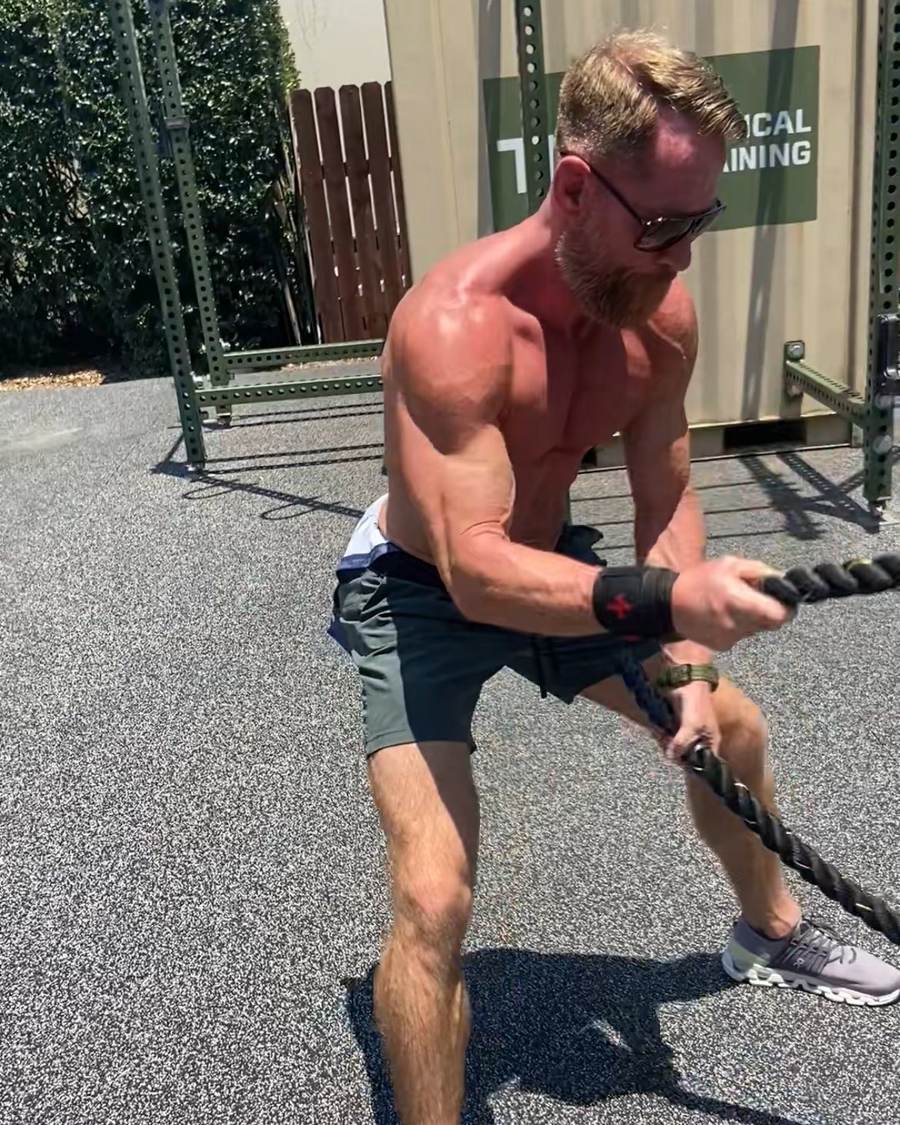
I had this exact conversation recently with one of my guys. Former MP and law enforcement, successful business owner, and more importantly, a devoted husband and father. He's been with me for months. I quietly shifted his training toward tactical conditioning a while back. He checked his ego at the door and got after it. That guy is ready for chaos now. He didn't start that way — he trained that way. He can roll with me anytime.
And one more thing, since I know it matters: train like this a few times a week and you'll be in better shape for your wife, too. Dead on.
So — Asset or Liability?
It's time for every man in our demographic to take a good, honest look in the mirror. If you need motivation to get off your ass, ask yourself one question:
Are you an asset, or are you a liability?
If you can't take care of your own health and protect the people you love, you're a liability. Fix that.
— Carl Simpson, Co-Founder · Real Lyfe Fitness
Frequently Asked Questions
Is it too late to get back in shape after 40?
No. The decline most men blame on age is mostly disuse, not destiny. Muscle and explosive power respond to training at any age — research shows meaningful gains even in people in their 80s — and consistent aerobic work can cut the typical rate of decline roughly in half. You're not starting from zero. You're starting from wherever you are, and that's enough.
At what age do men start losing strength and physical capacity?
Earlier than most guys think. Muscle loss can begin in your mid-30s, around 1 to 2 percent a year, and it speeds up every decade you ignore it. Aerobic capacity drops roughly 10 percent per decade after 30 if you're sedentary. The trap is that the slide is gradual enough that you won't feel it day to day — until the moment you actually need your body to perform.
What is tactical conditioning?
Tactical conditioning is training built around real-world physical readiness instead of just aesthetics or gym numbers. It blends strength, explosive power, and both anaerobic and aerobic capacity so your body can respond under pressure — sprint, lift, carry, grapple, or keep going when it counts. It's the difference between looking capable and being capable.
Why does explosive power matter more than raw strength as I age?
Because power — the ability to produce force quickly — fades faster than strength does, and the fast-twitch fibers behind it are the first to go. Those are the exact fibers you'd use to sprint, jump, or react in an emergency. A man can still look strong and test fine on slow lifts while having lost the explosiveness that actually matters when something goes wrong. Training for speed and power, not just heavy slow reps, is how you protect it.
How can I tell if I've lost my physical capacity?
Be honest with yourself. When's the last time you ran full-out for more than five seconds? Could you carry someone the weight of your kid up a flight of stairs? Could you move hard for a full minute without gassing out? You don't have to prove it to anyone — you just have to answer honestly. If the answers bother you, that's your starting point, not your verdict.
How often should I train to rebuild conditioning after years off?
For most men coming back after time off, a few quality sessions a week is enough to start reversing the slide — as long as they're consistent and progressive. Early on the goal isn't to crush yourself; it's to build a base you can stand on without injury or burnout. Consistency over months beats intensity for a week. Start where you are and build from there.
Ready to Do Something About Your Answer?
Pick the door that fits where you actually are.
The simplest way in. Take the free 60-second quiz and we'll point you to exactly where to start — no ego required, just start.
Find My Starting PointReal Vault — our full, ever-growing workout library, beginner to advanced, built to develop exactly the real-world capacity we just talked about. Self-paced, on your schedule.
Explore Real Vault — $49.99/mo1:1 Coaching. Hands-on. I build your training around where you actually are and where you need to be — and I hold you to it.
See 1:1 CoachingThe Tactical Conditioning Program
I'm building a dedicated program to make you genuinely ready for chaos — not just gym-strong. Want first access when it drops? Drop your email and I'll put you on the list.